Battle Formations
Vyuhas
Battle formations of the Mahabhaaratha wars were called vyuhas. Each of these vyuhas was an arrangement of army units, shaped like a bird, animal or an everyday object.
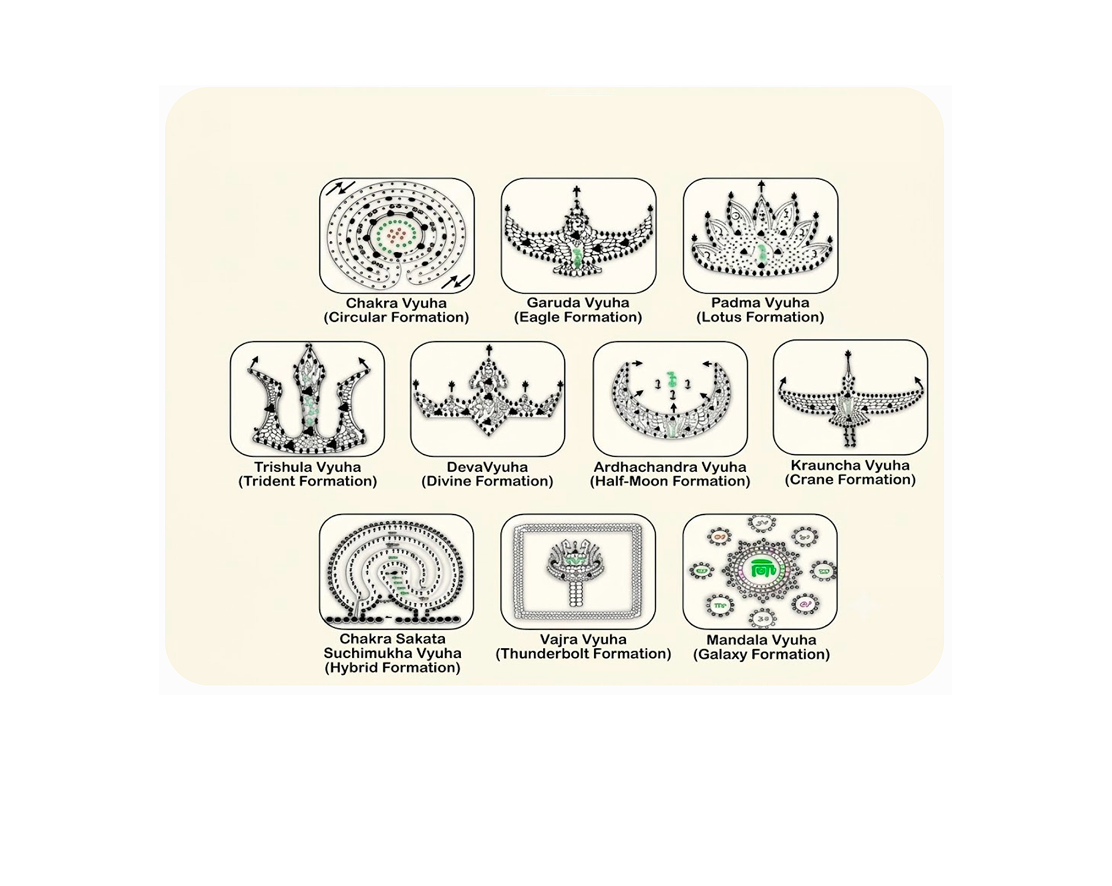
Some well-known vyuhas were krauncha (crane), nakshatra (star), trishoola (trident), makara (crocodile), ardha chandra (half-moon), garuda (eagle), garbha (womb), shakata (cart), mandala (galaxy), chakra (wheel) and padma (lotus). The names were based on their appearance from an aerial view.
But, these complex battle formations were created without the aid of an aerial view. They were strategically created with precise planning of commanders, memorisation of placements by soldiers, quick realignments based on alertness to audio cues in the form of coded drum beats or blowing of conches and horns. The vyuhas were dynamic in nature and were constantly improvised by the strategists, realigning and restructuring mid-battle.
Each vyuha was created with a specific purpose. Some were formed to mount an offensive like piercing the enemy formations, some to trap enemy warriors, some to protect certain people, some were defensive in nature, some to counter the use of specific astras etc.
Many of the vyuhas had prescribed counter vyuhas. Attacks were not random but were carefully chosen pre-determined targets.
The following are some of the vyuhas, along with information on placements, purpose and the day of deployment [courtesy: Reddit]
Sarvatomukhi danda Vyuha
Deployed by Bheeshma on the first day of the war. The head of the formation had six Maharathis and the rear was shaped like a rod.
Chakra Vyuha
A constantly rotating spiral of concentric circles – extremely hard to penetrate and almost impossible to escape from. Only elite warriors with exceptional memory, math skills and agility could navigate its layers.
Padma Vyuha
Deceptively open formation that closed violently like petals trapping prey, with the layers protecting the elite centre (often kings/warriors). Ideal for luring and isolating enemies. Used by Kauravas on Day 13 to isolate and finish Abhimanyu.
Garuda Vyuha
Shaped like a mighty bird - strong at the centre (protecting a VIP/commander) with wings for powerful flanking attacks. Used multiple times by the Kauravas, especially under Bheeshma on Day 2 & 3.
Trishula Vyuha
Inspired by Lord Shiva's weapon — three simultaneous prongs: one frontal assault + two flanking strikes. Perfect for splitting and collapsing enemy lines. Used by Pandavas on Day 8.
Deva Vyuha
A rarely used complex layered layout reflecting celestial formations. Deployment and execution required intense training. Formed by Pandavas on Day 10.
Ardhachandra Vyuha
Defensive-offensive hybrid formed in the shape of a half- moon/ crescent. It absorbed the enemy's charge, then enveloped it from the sides. Great for counter-attacks and controlled retreats. Pandavas used it on Day 3, 12, and 16.
Krauncha Vyuha
Tall, narrow, and piercing — sharp ‘beak’ to break tight enemy formations, with wings to envelop the enemy. Required elite coordination. Used by both sides: Pandavas on Day 2, 11, 18; Kauravas on Day 6.
Vajra Vyuha
Concentrated power at a single point — based on Indra's weapon, the thunderbolt. It was an extremely strong defence capable of absorbing heavy impact and retaliating with crushing force. A rare but formidable formation used when greatly outnumbered. Pandavas deployed it on day 1, 7 and 15.
Mandala Vyuha
Complex spirals inspired by cosmic geometry. Required perfect synchronisation — meant to confuse enemies while maintaining balance. Used by Kauravas on day 4 and 7 and by Pandavas on day 9.
Chakra-Shakata/Suchimukha Vyuha
Formations within formations — like a needle (Suchimukha) that pierces then expands into a cart-wheel (Shakata). Required tactical brilliance, unimaginable unity and intuition. Used by Drona to protect Jayadratha from Arjuna.